The Central Florida real estate landscape is moving at an unprecedented pace. As we cross the mid-point of 2026, our region has transcended its reputation as a global tourism hub to become one of the nation’s most formidable macroeconomic powerhouses. Driven by historic corporate relocations, massive technological growth in corridors like NeoCity, and steady population influxes, finding your perfect home here requires a sophisticated, data-driven approach.
Hi everyone! I’m Angela Rodriguez, Broker-Owner of Dream Finders Realty Group. Every day, my team and I assist local families, out-of-state relocations, and international investors as they navigate the fast-paced submarkets of West Orange, Lake, and Osceola counties. One of the most critical questions I receive from clients today is: “Angela, should I buy a brand-new construction home, or should I focus on an established resale property?”
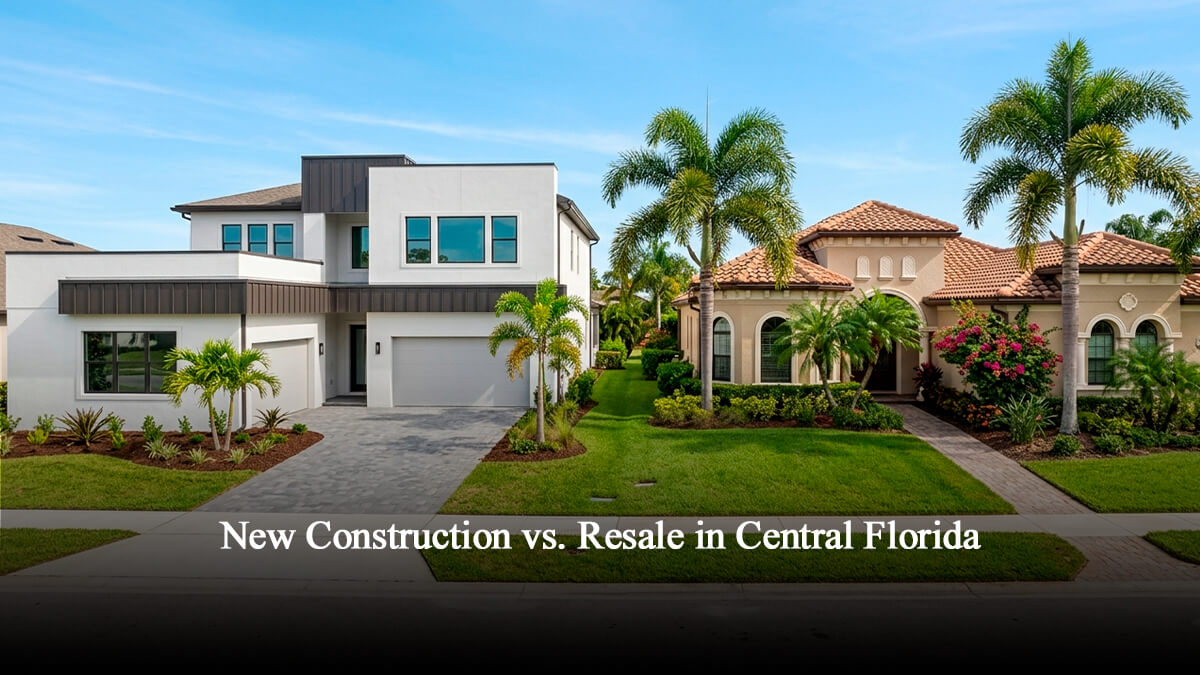
The answer isn’t a one-size-fits-all formula. The local dynamics of 2026 demand that you weigh builder finance incentives against mature neighborhood placement, modern building codes against larger lot sizes, and immediate move-in timelines against custom design personalization. In this deep-dive guide, I will break down the structural, financial, and hyper-local realities of both pathways so you can make an empowered decision.
1. The Reality of the 2026 Central Florida Market
Before analyzing the specific property types, we must anchor our strategy within today’s unique economic reality. Many buyers mistakenly believe that sitting on the sidelines to wait for an aggressive drop in interest rates is the smartest move. However, as I always remind my clients, waiting for lower rates can often be a costly error. Because home buyer demand across Orlando remains structurally high, even a minor downward tick in interest rates instantly unleashes waves of sidelined buyers. This influx triggers intense bidding wars, effectively driving up asset prices and erasing any theoretical savings on your monthly mortgage note.
Furthermore, building costs and skilled labor inflation have profoundly altered consumer behavior. Over the past couple of years, we have observed that affluent buyers and savvy professionals are actively bypassing homes that require immediate, heavy remodeling. Instead, there is a clear market consensus favoring move-in-ready luxury properties in Central Florida to avoid the soaring expenses, logistical delays, and mental fatigue associated with post-closing renovations. This shift makes the choice between new builds and pristine resales more relevant than ever.
2. Unpacking New Construction in Central Florida
Purchasing a brand-new home in master-planned communities like Horizon West in Winter Garden or Lake Nona’s newest phases is an incredibly attractive proposition. However, maximizing your return requires understanding the distinct advantages and potential blind spots of the new build sector.
The Advantages:
Unmatched Financial Incentives: In 2026, volume builders are acting as pseudo-lenders, offering aggressive financing structures that traditional resale sellers simply cannot match. To move their inventory, many builders are offering permanent interest rate buy-downs, covering a significant portion of your closing costs, or throwing in premium design upgrades at no additional cost.
The Modern Insurance Advantage: This is perhaps the single most impactful factor in Florida today. Brand-new construction homes are built to the absolute latest version of the Florida Building Code. This means they feature advanced hurricane strapping, impact-resistant windows or advanced engineered shutter systems, and modern fire-retardant materials. From an insurance underwriting perspective, these features are gold. A new construction home automatically qualifies for premium wind mitigation credits, significantly lowering your overall Florida home insurance 2026 costs and monthly payments.
Energy Efficiency: Modern insulation (such as radiant barrier roof decking and double-pane low-E windows) along with high-efficiency variable-speed HVAC units means your monthly utility bills will be substantially lower than a home built 15 or 20 years ago.
The Drawbacks:
The Premium Price Tag: On a price-per-square-foot basis, new construction typically commands a premium over comparable resale homes.
Lot Size Limitations: Modern master-planned communities prioritize community green spaces and extensive trail networks, which often means individual residential lot sizes are smaller and closer together.
CDD Fees: Many new construction developments utilize Community Development Districts (CDDs) to fund master infrastructure (roads, major lakes, master clubhouses). This fee is tacked directly onto your annual property tax bill, increasing your monthly carrying costs.
3. Evaluating Resale Properties in Established Neighborhoods
On the other side of the equation lie Central Florida’s established, mature communities. From the sweeping tree-lined streets of older Windermere enclaves to the established corporate-accessible suburbs of Orange County, resale properties offer timeless benefits that cannot be manufactured overnight.
The Advantages:
Prime Location and Land Volume: Established homes were built when prime real estate was widely available. Consequently, resale properties frequently boast significantly larger lot sizes, mature, canopy-providing landscaping, and a greater sense of privacy between neighbors.
Predictable Carrying Costs: When evaluating an established community, the HOA structure is fully stabilized, and CDD fees are often non-existent or close to expiration. You know exactly what the neighborhood culture is, and you won’t have to deal with the noise, dust, and visual clutter of ongoing heavy machinery construction outside your door.
Immediate Delivery: Unlike a new build that may take 6 to 10 months to complete from the dirt phase, a resale home can typically close and be ready for move-in within 30 to 45 days, depending on your financing alignment.
The Drawbacks:
Capital Expenditure Risks: Even if a resale home looks visually stunning on the surface, core systems may be approaching the end of their operational lifespans. Replacing a concrete tile roof, a commercial-grade pool pump, or a multi-zone HVAC system can cost tens of thousands of dollars immediately after moving in.
The Insurance Premium Penalty: Older roofs and non-mitigated structural profiles mean insurance carriers view the property as a higher risk. Without modern wind mitigation features, your annual property insurance premiums can be double or triple what a brand-new home costs, eating away at the savings from a lower initial purchase price.
4. Hyper-Local Submarket Analysis
Where you choose to deploy your capital matters just as much as the age of the structure itself. Central Florida is a mosaic of micro-markets, each trending differently as highlighted by regional authorities like the Orlando Economic Partnership.
If you are evaluating West Orange County, you are likely torn between two massive powerhouses. I break this down completely in my dedicated analysis of Winter Garden vs Windermere: Where to Buy in 2026?. In short, Winter Garden represents the absolute gold standard for new construction velocity and master-planned urban design via the Horizon West corridor. Conversely, Windermere remains the crown jewel of luxury resale stability, where its historic sand-bottom Butler Chain of Lakes creates an irreplaceable barrier to entry for new developments, ensuring premium value preservation for established estates.
Meanwhile, over in Southeast Orlando, Lake Nona (known globally as Medical City) blends the two concepts seamlessly, offering cutting-edge smart-home new construction alongside highly coveted, beautifully established resale neighborhoods that sit within walking distance of elite biomedical research hubs.
5. Crucial Consumer Protections: The New Build Blindspot
No matter which path you choose, protecting your hard-earned equity must remain your highest priority. One of the most dangerous, recurring blindspots I see buyers fall into when purchasing new construction is assuming they can bypass traditional consumer protections.
Many buyers think, “The home is brand new and passed all local city and county building inspections, so I don’t need to hire an independent home inspector.” As a broker who reviews these contracts every single day, let me be perfectly clear: a municipal code inspection only verifies that a structure meets the bare minimum legal requirements for human habitation. It does not evaluate high-level craftsmanship, nor does it guarantee that a rushed subcontractor didn’t accidentally leave an attic AC duct unsealed, reverse the electrical polarity on kitchen outlets, or omit vital structural flashing on the roof line.
To safeguard your wealth, you must understand why you need a home inspection for new builds in Central Florida. An independent, state-licensed inspector acts exclusively as your advocate, catching critical deficiencies before they are covered by drywall or finalized at closing. Rest assured, my team ensures that every single transactional line item—from earnest money escrows to professional third-party inspection allocations—is fully mapped out ahead of time. You can review the complete parameters of these fees in our comprehensive Central Florida Closing Costs Guide 2026.
6. Comprehensive Central Florida Real Estate Q&A
What specific household income is needed to buy a house in Orlando in 2026?
The exact number depends on your down payment allocation, existing consumer debts, and your target neighborhood’s specific price points. However, based on current median sales data, a household generally requires a verified annual income needed to buy a house in Orlando ranging between $95,000 and $120,000. This baseline allows you to comfortably cover principal, interest, localized property taxes, and home insurance while keeping your overall debt-to-income (DTI) ratio well within safe federal underwriting guidelines. For premium master-planned developments or exclusive luxury enclaves, this threshold will naturally adjust higher.
Is it better to buy a home or rent first when moving to Central Florida?
If you are entirely unfamiliar with our regional layout, a brief short-term lease can provide a small window to explore different areas. However, if you are relocating with long-term professional or family stability in mind, purchasing a home immediately is almost always the superior financial move. Renting means paying a 100% interest rate to a landlord while completely missing out on real estate appreciation and equity compounding. Securing your asset early allows you to lock in your housing costs and begin building long-term generational wealth from day one. I dive into this economic math heavily in my guide on whether you should buy or rent first when moving to Central Florida.
How do modern Florida home insurance regulations affect new builds vs. resale?
Florida insurance carriers heavily incentivize structural modernization. Because new construction adheres to the strict recent revisions of the Florida Building Code, insurers face vastly reduced risk exposure. As a result, a new construction home can easily see annual insurance premiums that are 50% to 70% lower than an older resale home with an unmitigated roof or aging electrical panels. When buying resale, ensuring the property has an updated four-point inspection and wind mitigation certificate is non-negotiable to unlock competitive premium rates.
What are the average closing costs for a property buyer in Central Florida?
Typically, a buyer should anticipate closing costs to range between 2% and 5% of the total purchase price. These costs consist of lender underwriting fees, title search and insurance policies, state documentary stamps, independent appraisal allocations, and the mandatory pre-funding of your property tax and insurance escrow accounts.
How can international buyers safely protect their real estate investments here?
Foreign investors enjoy exceptional opportunities in Central Florida, particularly because Florida does not levy a personal state income tax, ensuring that net rental returns are highly optimized. To protect personal capital and streamline cross-border transfers, it is standard practice to structure the acquisition through a domestic legal entity like a Florida LLC. For a granular breakdown of withholding regulations, tax credits, and legal protections, make sure to read my comprehensive Central Florida Tax Incentives for Foreign Real Estate Investors (2026 Guide).
Summary: Which Path Wins Your Central Florida Journey?
Ultimately, choosing between new construction and a resale property comes down to balancing your lifestyle goals against your financial framework. If you want a turn-key asset, modern structural energy efficiencies, and aggressive financing buy-downs from a builder, new construction is an exceptional path. If you prioritize larger lot sizes, established neighborhood maturity, privacy, and immediate move-in timelines, focusing on prime resale properties will yield excellent rewards.
Navigating this high-stakes decision requires a dedicated, hyper-local advocate who knows how to analyze neighborhood data, deconstruct builder contracts, and protect your financial timelines from the initial offer to the closing table. For unbiased guidance on national consumer protection frameworks, loan disclosure rules, and lending standards, you can always consult federal reference tools like the Consumer Financial Protection Bureau (CFPB) or trade insights via Florida Realtors.
Are you ready to map out a customized, winning home-buying strategy tailored specifically to your family’s financial goals? Let’s connect today to turn your Central Florida real estate dreams into a concrete, wealth-building reality.
Angela Rodriguez
Broker-Owner | Dream Finders Realty Group
 (407) 993-1286 / @angela_turealtor