
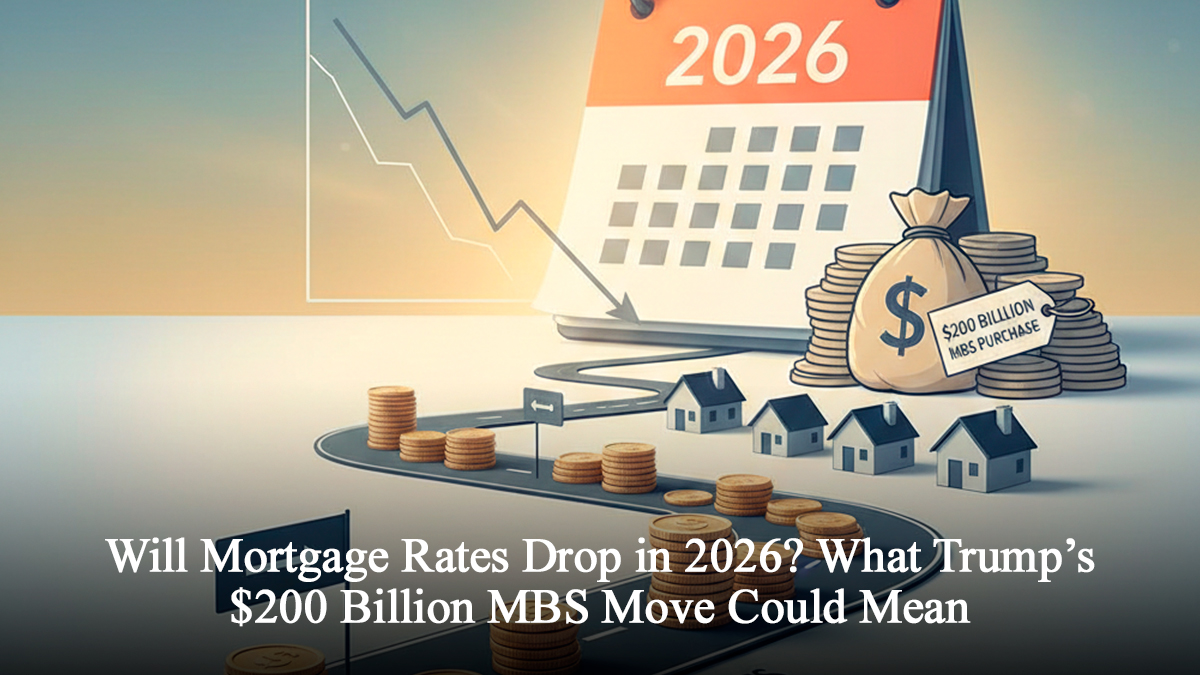
A major headline is circulating in the housing and finance world: President Donald Trump said he has directed Fannie Mae and Freddie Mac to purchase $200 billion in mortgage bonds (mortgage-backed securities, or MBS) with the goal of helping bring down mortgage rates and monthly payments.
If you’re planning to buy a home, refinance, or use your home equity in 2026, this matters—but it’s important to understand what this type of action can (and can’t) do.
Let’s break it down in plain English.
1) What exactly was announced?
According to reporting from Reuters and other outlets, Trump said he wants Fannie Mae and Freddie Mac to buy $200B in mortgage bonds (MBS) to help reduce mortgage rates and improve affordability.
This is notable because Fannie Mae and Freddie Mac are central to how U.S. mortgages are funded and priced—and they have been under federal conservatorship since the 2008 financial crisis.
2) What are MBS (mortgage-backed securities) and why do they affect mortgage rates?
An MBS is a bond backed by a pool of mortgages. Investors buy these bonds and receive payments based on the mortgage payments flowing into the pool.
Here’s the key connection:
When demand for MBS increases, prices can rise
When MBS prices rise, yields can fall
Lower MBS yields can translate into lower mortgage rates offered to borrowers (not always immediately, and not always one-for-one, but the relationship is real)
That’s why large-scale MBS buying gets attention: it can affect the “plumbing” of mortgage pricing.
3) Is this like what happened in 2020–2022?
It’s similar in mechanism (MBS purchases were part of what the Fed did during the pandemic era), but today’s environment is different—and expectations should be more cautious. Reuters notes that compared to the Fed’s much larger bond-buying programs, $200B may have a relatively small impact, with an estimate of about 10–15 basis points (0.10%–0.15%).
In other words: this could help, but it doesn’t automatically mean “pandemic-level” mortgage rates.
4) Where are mortgage rates right now?
Freddie Mac’s Primary Mortgage Market Survey (PMMS) reported the 30-year fixed-rate mortgage averaged 6.16% as of January 8, 2026.
Rates move based on multiple factors—not just one policy headline—such as inflation expectations, Treasury yields, investor risk appetite, and mortgage-market spreads.
5) Why this news matters to you (3 real-life scenarios)
Even a modest drop in rates can create opportunities—especially if you’re prepared.
A) If you’re planning to buy in 2026
If rates ease, you may see:
Slightly lower monthly payments
Improved affordability or qualification
More buyers re-entering the market (which can increase competition)
Smart move: get prepared before competition picks up—pre-approval, documents ready, and a clear plan for budget + location.
B) If you already own a home and you’re thinking about refinancing
If rates trend down and you locked in at a higher rate, refinancing might help:
Lower the monthly payment
Improve loan terms
Restructure finances
Important: refinancing depends on your current rate, closing costs, and how long you plan to keep the home. A lender can run a break-even analysis.
C) If you want to use your home equity
If you’ve built equity, you might explore options to:
Renovate strategically
Invest (e.g., purchase another property)
Consolidate certain debts (case-by-case)
Equity can be powerful—but it should be used intentionally and with clear numbers.
6) Could this push home prices up?
Potentially. Some analysts have raised concerns that policies aimed at stimulating demand—without increasing housing supply—can put upward pressure on prices.
That’s why being ready matters: when buyers rush in, the best homes go first.
7) What should you do right now? (Quick checklist)
If you want to buy
Get a true pre-approval (not just a quick pre-qualification)
Set your target based on a comfortable monthly payment
Keep documents ready (income, bank statements, IDs)
Ask about options like seller concessions or temporary rate buydowns (when available)
If you want to refinance
Compare your current rate vs. today’s market
Ask for multiple scenarios (term options, costs, break-even timeline)
If you want to use equity
Define the goal (renovation, investment, etc.)
Run numbers: total cost, monthly impact, and risk
FAQ
Can this policy “guarantee” lower mortgage rates?
No. It can influence mortgage markets, but rates depend on many moving parts. Reuters reports estimates suggesting the impact could be modest.
Is this the Federal Reserve buying MBS?
This report centers on Trump directing Fannie Mae and Freddie Mac to buy MBS—not the Fed’s bond-buying program.
Will rates go back to pandemic lows?
Most commentary indicates that today’s environment is different, and a dramatic return to those levels isn’t the base expectation.
Conclusion
Trump’s call for $200 billion in MBS purchases is important because it could help nudge mortgage rates down—possibly creating better windows for buying, refinancing, or planning around your equity in 2026.
If you’re thinking about buying in Central Florida in 2026, refinancing, or using your home equity, I can help you review your numbers and build a clear plan.




 English
  Spanish