
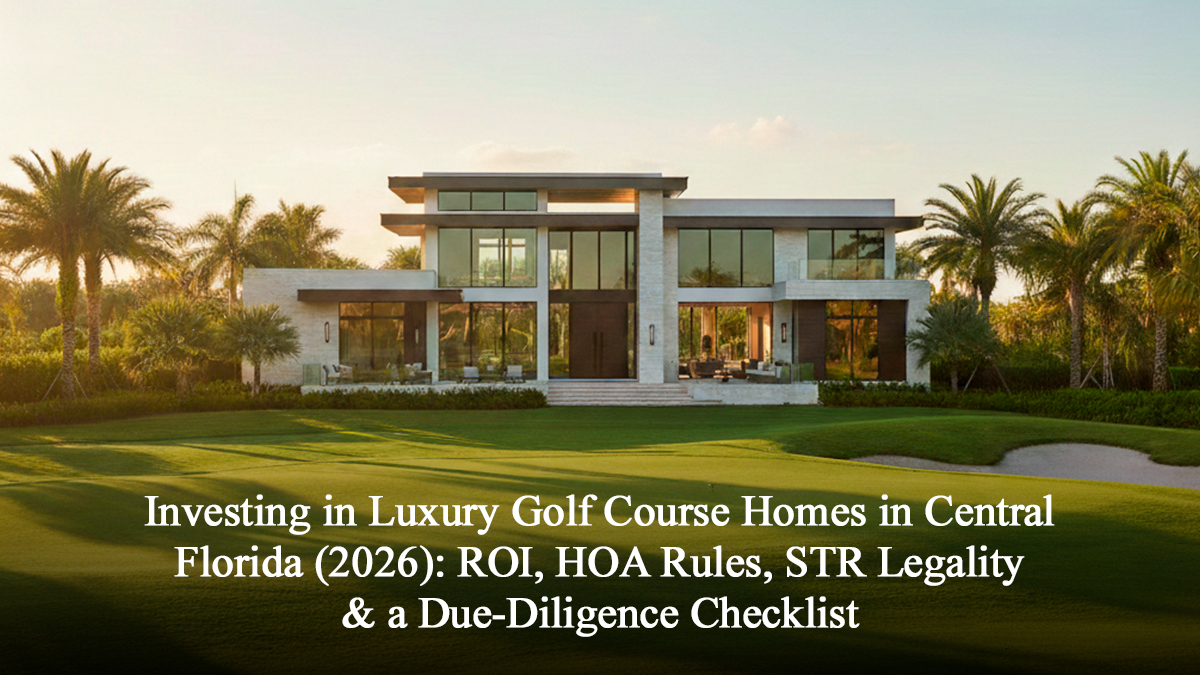
If you read yesterday’s post—“Luxury Golf Course Homes in Central Florida: A Buyer’s Guide That Helps You Decide”—today’s article is the investor edition.
Because when you invest in a luxury golf community, you’re not just buying a home—you’re buying a business model. And in Central Florida, that model can change dramatically depending on HOA rules, club fees, zoning, and short-term rental (STR) regulations.
Below is a practical, investor-focused checklist to help you evaluate whether a luxury golf course home in Central Florida is a smart investment—especially if your plan includes STR income.
Disclaimer: This is general information, not legal or tax advice. STR rules can change and vary by city, county, and HOA/club documents. Always confirm the latest requirements with the proper jurisdiction and your community’s governing documents.
1) Choose Your Strategy First: STR vs. Mid-Term vs. Long-Term
Before you run a single ROI calculation, decide how you plan to monetize the property:
Short-term rental (STR): nightly/weekly stays (tourism-driven).
Mid-term rental: typically 30+ days (relocations, medical professionals, corporate stays).
Long-term rental: 6–12 months+ (more stable, usually fewer turnovers).
Why it matters: local rules may treat “short-term” differently. For example, Orange County explicitly addresses short-term/transient rentals and notes that where they’re allowed depends on zoning or Planned Developments where permitted.
Investor takeaway: A “perfect” property isn’t perfect if your intended rental strategy isn’t allowed where it’s located.
2) The Zoning Reality Check (The Step Most Investors Skip)
In Central Florida, “Can I do STR here?” is not a guess—it’s a verification process.
Orange County (many areas around Orlando/Windermere)
Orange County’s zoning guidance states that short-term rental (length of stay of 179 days or less) is permitted only in specific Commercial/Industrial zoning districts or in Planned Developments where it is expressly permitted.
It also defines single-family transient rental as renting/leasing a single-family dwelling for less than 30 days, and says it is permitted only in the R-3 district, and prohibited in other zoning districts.
Osceola County (many resort/golf investment areas near attractions)
Osceola County provides a public Short-Term Rental List and Short-Term Rental Overlay Map through its permitting resources.
That’s a strong starting point to validate STR geography before you commit to a purchase.
Investor takeaway: Always confirm:
City vs. unincorporated county jurisdiction,
zoning/overlay permission, and
HOA/club rules.
3) Community Rules Can Make or Break Your ROI (HOA + Club)
Luxury golf communities offer lifestyle and prestige—but investors must model the real operating structure.
Costs you should always model (even before making an offer)
HOA dues (and what they actually include)
Possible club membership costs (initiation + monthly dues, if required)
Landscaping/pool care and higher-end maintenance
Reserves/special assessment risk
Any community restrictions that affect guest/renter demand
HOA rules that matter most for investors
Minimum lease term (30/90/180/365 days)
Rental caps (limits on how many homes can be rented)
Tenant approval process (applications, fees, timing)
Occupancy limits, parking rules, noise rules
Restrictions on STR advertising or platforms
Investor takeaway: In luxury golf communities, your governing documents can matter more than your interest rate.
4) Florida DBPR Licensing: The State Layer Many Investors Miss
Even if a city/county allows STR, Florida may still require state-level licensing in certain situations.
Florida’s DBPR guidance explains that if you rent the entire unit more than three times in a calendar year for stays under 30 days (or one calendar month, whichever is less)—or if it’s advertised as regularly rented—licensing applies.
Investor takeaway: STR compliance can be state + local + HOA. Build that into your due diligence timeline and your operating budget.
5) City Requirements Example: Kissimmee (Why “City vs. County” Matters)
Many investors search “Kissimmee STR” and assume one set of rules applies everywhere. Not necessarily.
The City of Kissimmee emphasizes verifying whether a property is actually within city limits, noting that an address may say “Kissimmee” while being in unincorporated Osceola County (where different processes apply).
Airbnb’s Kissimmee regulatory page also notes that:
a Conditional Use Permit may be required for many operators, and
hosts may need a Short-Term Rental Business Tax Receipt, and the city may not accept an application if it’s inconsistent with zoning.
Investor takeaway: Always confirm jurisdiction first, then confirm the exact permits/approvals.
6) Polk County Note (If Your Investment Search Includes Davenport/Haines City Areas)
If your search expands into Polk County (common for resort-style and golf-adjacent investment inventory), Polk County’s Tax Collector technical advisory states that individuals or businesses renting short-term rental accommodations for six months or less must obtain a Class B county local business tax receipt for each rental location.
That advisory also notes proof of an applicable DBPR state license may be required prior to issuance of the county tax receipt.
Investor takeaway: County-level business tax requirements can be part of your compliance cost and timeline.
7) ROI Drivers Specific to Luxury Golf Course Homes
These are the levers that often move both rental performance and resale value in golf communities:
A) Lot position and view premium
Golf-front lots may command a premium, but also consider privacy, noise, and long-term desirability (buyers vary).
B) Floor plan that fits the renter profile
For STR or executive rentals, layouts that usually perform better include:
multiple en-suite bedrooms,
a true office,
large entertaining areas,
strong indoor/outdoor flow,
“group-friendly” amenities (media/game space).
C) Amenity stack and community experience
Luxury renters and buyers pay more for lifestyle: gated security, clubhouse, dining, tennis/pickleball, high-end landscaping standards, and strong community reputation.
D) Location logic
Tourism-driven STR strategies often prioritize accessibility to attractions and highways; executive rentals tend to prioritize proximity to hospitals, airports, and business corridors.
8) Investor Due-Diligence Checklist
Use this checklist before removing contingencies:
Legal + regulatory
Confirm city vs. unincorporated county jurisdiction.
Verify zoning/permission for STR (Orange County guidance is zoning-dependent).
If in Osceola County, review the Short-Term Rental List/Overlay Map resource.
Confirm DBPR licensing triggers if renting the entire unit short-term more than 3 times/year.
HOA + club
Obtain HOA docs and verify rental rules (minimum terms, caps, approvals)
Confirm whether club membership is required or optional
Review reserves, budgets, and assessment history
Financial model (ROI reality)
HOA + club fees + insurance + maintenance
Management + turnover costs (if STR)
Conservative vacancy assumptions
CapEx reserve (big-ticket repairs)
Property condition
Roof, HVAC, plumbing, pool equipment, drainage
Full inspection + specialty inspections as needed
FAQ
Are short-term rentals allowed everywhere in Orange County?
No—Orange County indicates STR/transient rental permission depends on zoning districts and certain planned developments, and notes prohibitions in other districts.
Why does “Kissimmee” sometimes mean different rules?
Because a property may have a Kissimmee address but be in unincorporated Osceola County; the City advises confirming city limits.
Does Kissimmee require extra approvals for STRs?
Airbnb’s regulatory page notes a Conditional Use Permit may be required for many operators and that a short-term rental business tax receipt is needed.
If I invest in Polk County, do I need a local business tax receipt for STR?
Polk County Tax Collector guidance indicates Class B local business tax receipt requirements for short-term rental accommodations (six months or less).
Conclusion
If you’re considering investing in a luxury golf course home in Central Florida, I can help you:
shortlist communities based on your strategy (STR vs. long-term),
model real-world ROI (including HOA/club costs),
and verify the rules that protect your investment before you commit.
Send me your price range, preferred use (STR or long-term), and must-haves (golf-front, private pool, number of bedrooms), and I’ll help you identify options that make sense financially and legally.



 English
  Spanish