
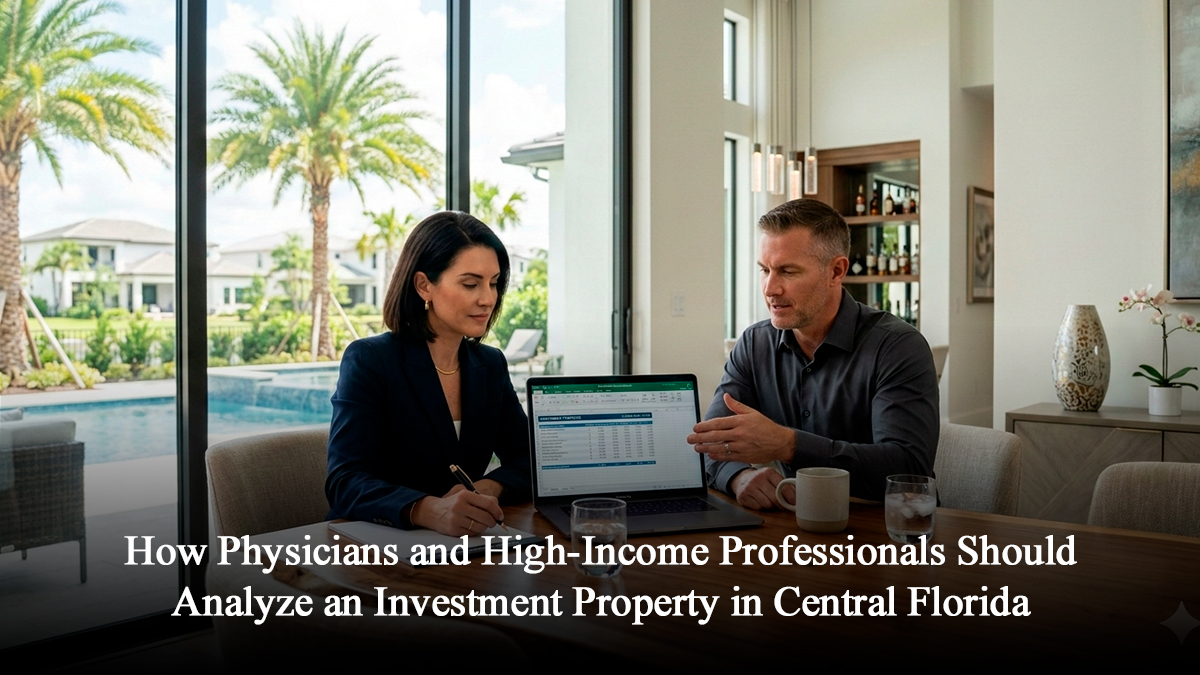
If you are a physician or a high-income professional thinking about buying an investment property in Central Florida, one of the biggest mistakes you can make is confusing a beautiful home with a strong investment.
I see this all the time.
A property may look impressive, sit in a well-known community, and still underperform because the numbers, the location dynamics, or the exit strategy were never analyzed properly. And in a market like Central Florida—where buyers currently have more inventory and more room to negotiate than they did in the ultra-competitive years—being selective matters more than ever. In the Orlando area, January 2026 inventory reached 11,741 homes, new listings jumped to 3,852, average days on market rose to 81, and the reported mortgage rate held at 6.0%. That is exactly the kind of environment where disciplined analysis can create an advantage.
I’m Angela Rodríguez, and when I help physicians, executives, and relocation clients buy in Central Florida, I always recommend analyzing an investment property through five lenses: purpose, location, true carrying cost, demand profile, and exit strategy.
1. Start with the purpose before you analyze the property
Before you look at price, finishes, or even neighborhood prestige, define what this purchase is supposed to do for you.
- Is this a pure rental property?
- A future primary home that you may rent later?
- A second home with appreciation potential?
- A relocation purchase that needs to protect your downside in case your job or life changes?
This matters because the “right” investment property for a physician in Lake Nona is not necessarily the same as the right property for an executive who wants to be closer to Windermere, Winter Garden, Dr. Phillips, or Celebration. My own market positioning is already centered on these Central Florida areas that are friendly to both physicians and investors, so the analysis should remain hyperlocal instead of treating “Orlando” as a single market.
2. Analyze the location like an operator, not like a tourist
The next question I ask is simple: who will want this property after you?
That future person might be a tenant. It might be a relocating buyer. It might be another high-income professional. But if you cannot clearly identify the next likely user of the property, that is a warning sign.
For physicians in particular, hospital and medical-employment corridors matter. Lake Nona stands out because its health and life sciences cluster includes major institutions such as the Orlando VA Medical Center and the UCF Health Sciences Campus, which helps support long-term housing relevance in that corridor.
In practical terms, I usually recommend looking at questions like these:
How easy is the commute?
Is the community attractive to other professionals with similar incomes and schedules?
Does the area have strong long-term livability, not just marketing appeal?
Would this property still be desirable if the market softens?
A polished house in an over-niched location is not always better than a simpler property in a more liquid area.
3. Build the real monthly cost, not the optimistic version
This is where many high earners make expensive mistakes.
They focus on purchase price and mortgage payment, but they underwrite the property too loosely. In Central Florida, I want clients to calculate the full carrying cost:
- Principal and interest
- Property taxes
- Homeowners insurance
- Flood insurance, if needed
- HOA or condo fees
- CDD, if applicable
- Maintenance reserves
- Leasing or management costs
- Vacancy reserves
For investment analysis, flood and insurance exposure must be checked at the address level, not guessed by ZIP code. FEMA’s Flood Map Service Center is the official source for flood hazard information, and FEMA also notes that standard homeowners insurance does not cover flood damage.
I also remind buyers that a rental or second-home investment should not be modeled like a homesteaded primary residence. Orange County Property Appraiser materials note that non-homestead properties include rental properties and second homes, and that the 10% cap applies to non-homestead property rather than homesteads. That is a useful reminder when you project future taxes.
4. Look at demand, not just appreciation
A lot of affluent buyers assume a great area will automatically mean a great investment. Sometimes that is true. Sometimes it is not.
I prefer to ask:
- What type of tenant would rent this property?
- What type of buyer would purchase it in three to seven years?
- Is the floor plan practical?
- Are the HOA rules friendly to leasing?
- Is the home too customized for the next buyer pool?
The best investment properties usually have more than one path to success. They may appeal to a relocating family today, a medical professional tomorrow, and an owner-occupant buyer later. That flexibility matters.
5. Always run an exit strategy before you make an offer
A strong investment purchase is not just about how you enter. It is also about how you exit.
Before I advise a client to move forward, I want to know:
Could this property rent quickly if plans change?
Would it resell easily in its price bracket?
Are the monthly costs low enough to protect you in a slower market?
Is the buyer pool broad enough to give you options later?
This is especially important for physicians and other high-income professionals, because career moves, practice changes, fellowship timelines, and family decisions can shift faster than expected.
6. Red flags I would never ignore
When I evaluate an investment property in Central Florida, these are some of the most common red flags I watch for:
- Overly aggressive rent assumptions
- High HOA or CDD costs that destroy cash flow
- Communities with restrictive lease rules
- Insurance or flood surprises discovered too late
- Luxury finishes in a location with weak resale depth
- A floor plan that looks impressive but is functionally hard to rent or resell
A property should work on paper before it wins emotionally.
Conclusion
If you are a physician or a high-income professional buying in Central Florida, my advice is simple: do not buy based on status alone. Buy based on numbers, location quality, future demand, and flexibility.
The right property in Winter Garden, Windermere, Lake Nona, Dr. Phillips, Celebration, Bella Collina, Clermont, or greater Orlando can absolutely become a smart long-term asset. But the decision should be made with clear underwriting, not assumptions.
That is how I help my clients buy with more confidence, less risk, and a better long-term strategy.
If you want to analyze a specific property, I can help you review the location, costs, resale potential, and investment logic before you make an offer.


 English
  Spanish