
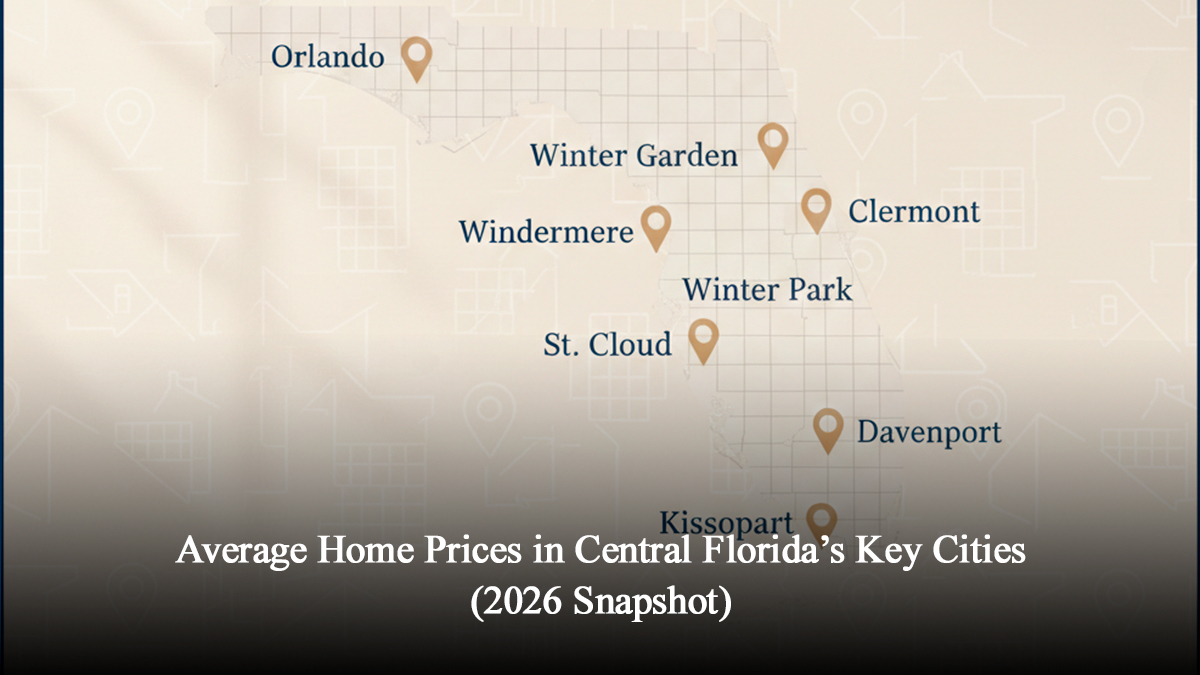
If you’ve been searching “average home prices in Central Florida,” you’ve probably noticed a problem: the number changes depending on the source, the month, and even the definition of “average.”
To keep this clear and useful, this report uses median sale price (not the mathematical average). Median is the most widely used benchmark in real estate because it’s less distorted by a handful of ultra-luxury sales or very low-priced transactions.
Below is a January 2026 snapshot (the most recent month available on many monthly market trackers as of February 20, 2026) for some of the most searched and most requested cities we serve across Central Florida.
Central Florida Home Prices by City (Median Sale Price)
| City | Median Sale Price | YoY Change (vs. last year) |
|---|---|---|
| Orlando | $410,000 | +1.2% |
| Winter Garden | $730,000 | +39.1% |
| Windermere | $925,000 | +59.5% |
| Winter Park | $618,750 | -13.5% |
| Clermont | $430,000 | -14.9% |
| Kissimmee | $326,000 | -1.2% |
| St. Cloud | $406,010 | +5.5% |
| Davenport | $326,950 | -1.7% |
Data source: Redfin city housing market pages (latest month shown; many indicate January 2026).
For context, the state of Florida showed a median sale price around $412,800 in January 2026.
What These Numbers Really Mean (And What They Don’t)
1) “Average” can mislead—median is more practical
A true “average” (mean) can jump dramatically if a small number of high-end homes sell in a given month. Median helps you compare cities more fairly—especially when one market has many luxury sales (Windermere) and another has more entry-level inventory (parts of Kissimmee/Davenport).
2) City-wide data is a starting point—neighborhoods move differently
In Central Florida, school zones, waterfront access, gated communities, new construction phases, and HOA/CDD structures can swing pricing significantly—even within the same ZIP code. That’s why professionals relocating (including physicians) often need a micro-market review (neighborhood-by-neighborhood) before making a decision.
3) Monthly snapshots are directional, not a final pricing tool
These are excellent for understanding where each city sits on the pricing spectrum. But a home’s real value depends on:
exact location (street + subdivision)
lot premium / water view
condition and upgrades
floor plan demand
insurance/taxes/HOA and community amenities
seller concessions and financing environment
Quick Market Read: How to Interpret the City Tiers
Luxury & lifestyle leaders
Windermere, Winter Garden, Winter Park tend to command higher pricing because of a mix of lifestyle amenities, school reputation, proximity to high-demand corridors, and (in many pockets) larger lots and upgraded housing stock.
What buyers should watch here: inventory mix month-to-month, new construction delivery timing, and how concessions/credits affect “net” pricing (especially in higher price points).
Balanced “core” markets for many relocations
Orlando, St. Cloud, Clermont frequently attract buyers who want commuting flexibility, a broader range of home styles, and more options across price brackets.
What buyers should watch here: days on market trends, the specific employment corridor you’ll rely on (downtown/medical hubs/theme parks/airport area), and the difference between “close to Orlando” vs. “commutes like Orlando.”
Value + investment corridors
Kissimmee and Davenport often draw buyers prioritizing purchase price, newer communities, or proximity to key travel/entertainment corridors. That said, pricing varies widely depending on whether the property is in a short-term rental-friendly area, a high-HOA resort-style community, or a more traditional neighborhood.
What buyers should watch here: HOA rules (especially rental restrictions), reserve funding/fees, and insurance considerations depending on property type.
How to Use This List If You’re Buying or Selling
If you’re buying:
Use the table to pick 2–3 “target cities” that match your lifestyle and commute.
Compare median price + trend direction (YoY up/down) to understand leverage.
Then switch to neighborhood-level comps (the step that actually protects your budget).
If you’re selling:
City medians are not your list price—but they shape buyer expectations.
The right strategy is a micro-comparable analysis (same community + similar model + similar upgrades).
In shifting conditions, sellers often win by focusing on:
pricing precision (not “testing high”)
presentation (photos, staging, repairs)
smart concession strategy (credits vs price drops)
The Angela Difference: City Data + Street-Level Accuracy
Data is helpful. But what wins in real estate is translating numbers into a specific plan for your property or your move.
Alongside my team at Dream Finders Realty Group, I specialize in the Central Florida market. We help buyers and sellers navigate every step of the process—from neighborhood selection and negotiation strategies to HOA/CDD considerations and luxury-level marketing.
If you want it, we can prepare a custom “Price Range + Neighborhood Match” report based on:
your commute targets
school preferences
lifestyle priorities (lakefront, golf, new construction, gated, etc.)
timeline (buy now vs. later in 2026)
Data Note
The city figures shown are pulled from monthly housing market trackers and represent median sale prices for the most recently reported month shown on each page (many reflect January 2026 at the time of writing).
Conclusion: What This Means for Your Move in 2026
Central Florida is not one market—it’s a collection of micro-markets. City-wide median prices help you understand the landscape, but the real advantage comes from narrowing down the right neighborhoods, HOA/CDD structures, commute patterns, and home features that match your lifestyle and budget.
If you’re planning to buy or sell in 2026, the smartest next step is to move from “city averages” to street-level data: recent comparable sales in the same community, similar floor plans, and similar upgrades—plus a negotiation strategy based on current inventory and demand.
If you’d like, my team at Dream Finders Realty Group and I can prepare a custom price range + neighborhood match report tailored to your goals, timeline, and priorities—so you can make a confident decision with my local expertise guiding every step.



 English
  Spanish